Blink Twice For Help
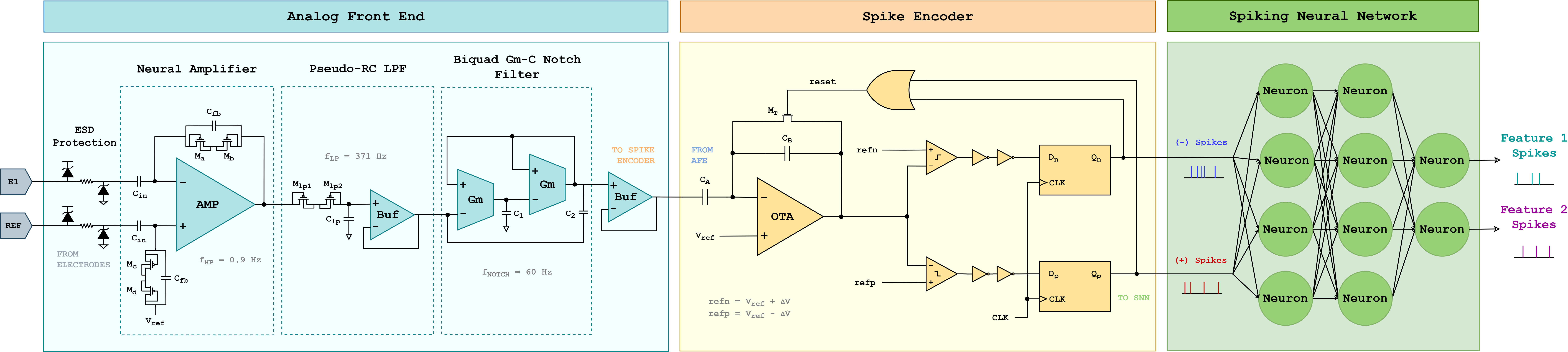
Fig. Block diagram of the complete system architecture.
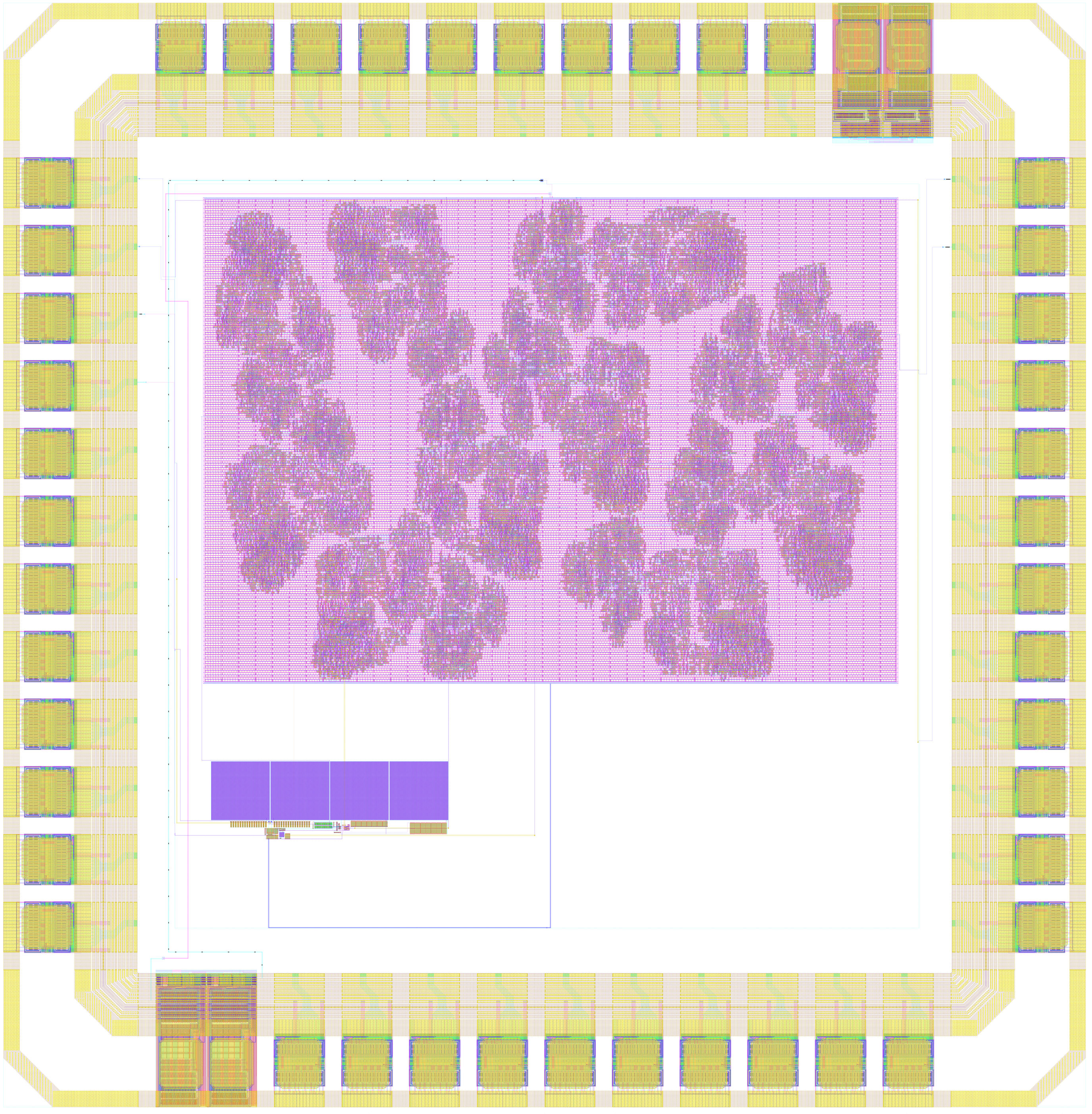
Sleep quality, attentional state, and real-time cognitive assessment are increasingly central to both clinical research and consumer health technologies. Conventional methods for monitoring these parameters often lack the temporal resolution, accuracy, or adaptability required for real-time applications. Eye movements, specifically blink duration and intensity, provide a promising, non-invasive biosignal for continuous tracking of cognitive states. In this work, we present a mixed-signal neuromorphic System-on-Chip (SoC) designed for real-time, low-power decoding of blink-based electroencephalogram (EEG) biosignals. Designed using the open-source 1.8V SkyWater 130nm CMOS process, the system integrates analog front-end circuitry with delta-modulation-based spike encoding and on-chip classification via a Spiking Neural Network (SNN). Our design supports applications in sleep and attention monitoring, cognitive workload analysis, and potential neuromodulation therapies for neurodegenerative and mental health disorders. The platform operates with high computational efficiency, making it ideal for future scaling into wearable and embedded systems. System-level validation was conducted using full-custom layout, simulation with real EEG blink data, and verification via the Cadence Design Suite. The final chip occupies 0.742 mm^2 of a 1.6 mm x 1.6 mm die, consisting of 276,542 transistors, and consumes 63.5 μW in the analog domain and 43 μW in the digital domain.
GitHub Repo
This work was completed as part of the Capstone Design Project for the ENEE408D Mixed Signal VLSI Design course, where I served as the team lead.
[Full Paper]